Showing posts with label Cavite. Show all posts

Thursday, February 16, 2017

A cool cycling trip to Tagaytay


My bike, Red, with Taal Lake and Taal Volcano on the background.
By now, you’ve probably noticed already the sudden drop in temperatures these past weeks. Some parts of Benguet Province are a freezing -2° Celsius, while in Metro Manila, it’s been fluctuating between 21° and 24° Celsius. It’s winter in many parts of the northern hemisphere and cold winds coming from Siberia, China and Japan are being blown into the country. Waking up these days are defined by sweater weather and cold feet. Taking a bath necessitates having hot water mixed with the tap water in your pail.

This is also a great opportunity to bike, given that it’s not too hot in the day and the chilly amihan provides a lot of ventilation.

And one of the many destinations that bikers in the Philippines love to go to in this kind of weather is Tagaytay City in Cavite, the Second Summer Capital of the Philippines after Baguio City in Benguet.

Last October, I attempted my first-ever bike ride from Bacoor to Cavite’s City of Pines. It’s a 35-kilometer distance from my home through uphill roads and foggy terrain (depending on the weather). 
Normally, bikers take the usual route via the Aguinaldo Highway, the main artery that passes through Cavite from Bacoor to Tagaytay City. However, the highway also has a reputation for being accident prone for both bicycles and motorists. Being that my safety is of my foremost concern, I decided not to go up to Tagaytay through the highway.

Instead, I took the safer route via the country roads of Silang to reach the city. From Bacoor, it’s just a straight line to Governor’s Drive in Paliparan, Dasmariñas City, where the Molino-Paliparan Road connects to Paliparan-Road that would lead me to the backdoor of Silang town.

I realized I never really talked about biking along Molino-Paliparan Road. This 23-kilometer road runs from Talaba Junction in Bacoor and goes all the way south to Paliparan, Dasmariñas City. Among the major roads in Bacoor that connect through it are Aguinaldo Highway, Bacoor Boulevard and Daang Hari. It also intersects with Salitran Road and Governor’s Drive in Dasmariñas City. It is probably one of the oldest roads in Bacoor since it passes through some of the older barangays of Bacoor like Aniban, Ligas and San Nicolas. As such, throughout much of its stretch through these barangays, the road is a two-lane asphalt that widens once you reach the barangays of Molino. Bikers must share the road with motorists in this section so tread carefully.

From Molino I to Paliparan, it transforms into a four-lane cemented road because much of the road widening can only be done in the newer barangays of Bacoor and Dasmariñas City. However, because of the widening, motorists tend to hog even the outer lanes, especially at intersections along Bacoor Boulevard and Daang Hari where traffic is common. After passing SM City Molino, it’s generally smooth sailing until you reach Paliparan.

After a rest at a 7-11 along Governor’s Drive in Paliparan, I made my way to the Paliparan-Silang Road, which is just a few meters to the right. Your landmark would be the Paliparan Barangay Hall. Paliparan-Silang Road is a two-lane concrete road that runs through subdivisions and sugarcane plantations in Dasmariñas and Silang. You would know you’re already in Silang because you’ll pass by a marker with a large clay pot on top. The Silang section of the road begins to have an incline because of the increasing elevation. You’ll also notice that flower and pineapple plantations, as well as flower and plant gardens begin to line the side of the road.

Before noon, I reached Silang Proper. I didn’t pass through downtown Silang though and instead pedaled through the back streets of the town. I had lunch of rice and dinuguan in one of the carinderias along Sabutan-Iba Road. After that, I made my way to Ulat Road, which is an old, two-lane road that leads all the way up to the Santa Rosa-Tagaytay Road. The uphill terrain is more pronounced here than in the previous roads. There were sections that I had to literally get off the bike and push forward. To make things worse, it began to rain and despite wearing a raincoat, I was drenched in sweat and moisture underneath. I was forced to stop and take shelter at a store in Brgy. Balite.

Posing with my bike to beautiful backdrop of Taal Lake behind.
Finally, after about an hour, the rain stopped, and I proceeded despite being wet, shivering and pedaling uphill. At around 2:30 p.m., I reached Santa Rosa-Tagaytay Road just near Tagaytay Haven Hotel, but still a few kilometers from a decent view of Taal Lake.

After an hour’s rest at a sari-sari store near Tagaytay Haven Hotel, I continued my journey southwest along Santa Rosa-Tagaytay Road. There’s plenty of traffic once you’re near the Tagaytay City Public Market because of an ongoing road construction. Plus, it was a Sunday, so there’s a bigger volume of vehicles on the road. Do take care while biking along this road because there are plenty of trucks and buses that ply this two-lane asphalt road that has no provision for sidewalks. Use hand signals to indicate turns or stops.

Around 3:30 p.m., I finally reached the Tagaytay-Calamba Road in front of the Tagaytay Econo Hotel. From there, one can already get a spectacular view of Taal Lake and Taal Volcano. I was shivering in the 24° Celsius weather, but I still made a few obligatory shots to record my achievement.

Having made it to Tagaytay, the next predicament was going home. Since it was already past the middle of the afternoon, I figured I’m going to be on the road until nightfall. It’s going to be a scary, dangerous gamble if I pedaled the way I came or if I go back via Aguinaldo Highway with only a lamp as my light. I decided not to take the risk and headed to Tagaytay Rotunda where I took Red and myself aboard a Baclaran-bound bus and went down at Patindig Araw, Imus, where I pedaled the rest of the way going home.

My total bike distance and time via MapMyRide.
All in all, my bike ride from Bacoor to Tagaytay was 35.49 kilometers long, which I completed in just four hours and five minutes. Not bad for an inaugural bike ride to the country’s Second Summer Capital. But for all the toils and sweat I poured for this tour, it was one of the coolest bike rides I’ve ever been to. I’ll definitely go back to Tagaytay this year and see if I can bike to and from it.

Like The Pinoy Cyclist on Facebook:

Sunday, January 1, 2017

2016: A year of cycles and pedals


Another turn of the year has passed. This is usually the time to look back at some of the major events that happened in the past 365 days. Hence, the multitude of year-end TV specials that air around this time. Being a well-traveled person, my journeys have allowed me to experience cycling in some of the most beautiful places to bike in the country. Here are my top cycling experiences of 2016:

February: Biking in Legazpi
Recently, I’ve taken up the practice of traveling alone to some far-off destination in the country. This started in 2015 when I backpacked through Negros Island and Siquijor. Having saved enough money this year, I set my sights on visiting Legazpi City in Albay to see Mayon Volcano. And just like what I did in Siquijor, I also took the opportunity to experience biking in this new destination.

Luckily, Legazpi City has some of the best bike infrastructures I’ve seen in the country, with bike lanes along Legazpi Boulevard and other major streets. There is also a bike shop, Motoragon Bike Shop and Bike Tours, that offers affordable bike rentals. When I visited the shop, it so happened that my celebrity idol, Rovilson Fernandez, was also taking a bike tour with the shop owner for his Malaysian travel show. The shop let me borrow a folding bike, which I used to go around the city looking for fancy restaurants and cool sights and activities. It was exhilarating biking around the city at night. By 9 p.m., the streets were literally deserted with very few vehicles on the road. If only it didn’t rain that hard on my second day there, I would’ve enjoyed the experience even more.

May: Giro di Luca in Bohol
When I first heard from my company that they’re sending me to Bohol for the annual Giro di Luca cycling event, I thought I died and went to bike heaven. After all, it’s quite out of this world for your company to send you and your bike to one of the most beautiful places in the Philippines just to bike!

Giro di Luca is an annual cycling event in Bohol that’s been going on for the last four years. It was established by veteran cyclist Gianluca Guidicelli, father of Kapamilya star and Ford Forza Triathlon member Matteo Guidicelli. My company sent me and my bike to the event as part of Ford’s promotional activities. They wanted me to experience the race for myself and see how reliable Ford’s fleet of vehicles were during the race. The three-day event covers as total of 500 kilometers in distance, which the cyclists must complete in three legs: Panglao to Guindulman in Day 1, Panglao to Carmen in Day 2 and Panglao to Tubigon on Day 3.

To make the story short, Red, my humble, 4,000-worth bicycle, was able to ride an airplane (in an embarrassing wraparound of box cartons) and ride with some of the biggest names in cycling in the country and abroad (including SportsU anchor Dyan Castillejo and Australian cycling power couple Belinda and Justin Granger)! And while I didn’t finish the race because of the physical toll of the distance, I saw how idyllic and picturesque it is to go around Bohol in a bicycle. It was a whole new way of experiencing Bohol.

September: Pedaling to General Trias
I’ve always wanted to visit Cavite’s other towns and cities on a bike. In 2015, Red and I reached Cavite City, Noveleta, Kawit, Rosario, Tanza, Ternate, Maragondon, GMA, and Carmona, while I’ve always biked through the cities of Bacoor, Imus and Dasmariñas since I was in my teens. That leaves the other upland towns and cities of Cavite for me to visit.

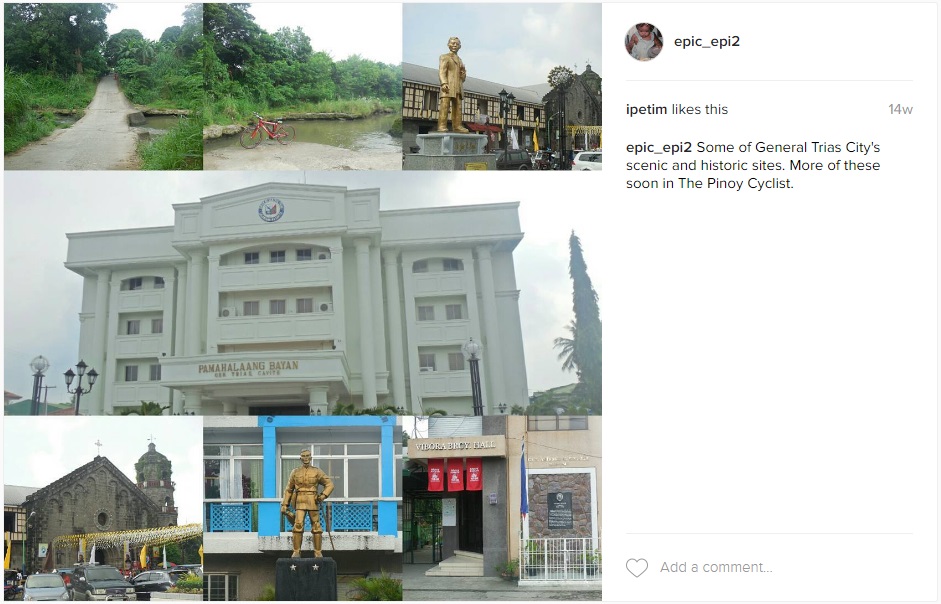
Through the wonders of Google Street View, I found a shortcut from my house to General Trias, Cavite’s newest city. In under two hours, I reached the historic city by passing through Patindig Araw in Imus City and Advincula Avenue in Lancaster New City. Among the places I visited were the St. Joseph the Worker Cathedral, the old Potente house where Andres Bonifacio once stayed, and the Vibora Cemetery where Artemio Ricarte, a general in the 1896 Philippine Revolution was buried. I also passed by the Alapan Flag Memorial in Imus City, where the Philippine flag was first waved in battle in 1898 a few months before it was officially unfurled during the Declaration of Philippine Independence in Kawit.

October: Uphill to Tagaytay
Aside from Kaybiang Tunnel in Ternate, the only other destination in Cavite that attracts many cycling enthusiasts is Tagaytay City. The challenging uphill terrain, combined with the city’s cool, mountain climate, makes it a magnet of cyclists.

Initially, I thought that biking to Tagaytay would be physically taxing for me given the terrain and distance. But since I was able to conquer Kaybiang Tunnel and the extraneous, mountain trail leading to it, I could make it to Tagaytay as well. My only other fear is biking along Aguinaldo Highway, which is most dangerous thoroughfare in the province. Again, through the wonders of Google Street View, I was able to map a route along the inner roads of Silang, Cavite to reach the city.

Amid a major downpour that stranded me in Silang for an hour and despite the difficult trail I took, I reached Tagaytay City chilly and wet in five hours. After several obligatory photos with the Taal Lake as my backdrop, I went to Olivarez Junction and placed Red on a bus back home. Not bad for a first-time bike ride to the country’s second summer capital.

November: A Bike Tour of Intramuros
Capping my year of biking adventure is my Intramuros bike tour in November. I’ve always wanted to do a bike tour of the Manila’s historic walled city and only UNESCO World Heritage Site and document certain sights in the district that only a bike can reach.

In under three hours, I was able to reach Intramuros via C5 Extension, Ninoy Aquino Avenue and Macapagal Boulevard. I visited Casa Real in Plaza San Luis, among the few museums in Manila I have yet to visit. I also passed by the Bambike Ecotours where I chatted with Bambike founder Bryan McClelland who showed me around his shop. Dropping by La Monja Loca, I thought I was going to see performance artist and tour guide Carlos Celdran, but he was on vacation. But I didn’t forget to buy his signature bowler hat from his “Damaso!” protest at the Manila Cathedral.

The rest of the tour took me to the ASEAN Garden in Puerta del Parian where there were busts of different ASEAN leaders. Red and I also biked through the pockmarked brick alleys above the walls and took photos of some of the lesser-known monuments in the former fortress city.

Postscript: In 2017, I hope you’ll continue to join me as I document my cycling experiences around the country, and hopefully, in some parts of the world! Let me raise a virtual glass and say, “Here’s to more memorable cycling experiences in the next 365 days!” Cheers!

Like The Pinoy Cyclist on Facebook:

Saturday, October 15, 2016

Cycling the Cavite-Manila route

There comes a time in every Pinoy cyclist’s life when you have to bike to the country’s capital city, Manila

This comes as a particularly tough challenge for me since I live in Cavite, and Manila is around 24 kilometers from our house. But this isn’t a challenge for the many construction workers that bike between Manila and Cavite to work on various infrastructure projects in the city. 

I’ve seen some of these folks during my daily commute to the capital. Most of them use mountain bikes given the bumpy conditions of roads leading to Manila, while a handful are in hybrids and road bicycles. It’s their daily ordeal the basically inspired me to purchase my bike, Red. Their bicycles cost around ₱2,000 to ₱4,000 but are very much dependable in different road conditions. 

From following them, I’ve learned that the usual route they take is through Las Piñas and Parañaque via Quirino Avenue. Of particular use to these cyclists is the Enrique Factor Road, a narrow passageway that passes under the Don Galo Bridge of the CAVITEX in Parañaque and connects Quirino Avenue to Diosdado Macapagal Boulevard. 

THROUGH LAS PIÑAS AND PARAÑAQUE
I took on the challenge of cycling the Manila-Cavite route one cloudy December day in 2014. Red was relatively new back then, having been purchased just a month before. I wanted to test if it was possible to bike going to my work in Manila and back. 

From Bacoor, I entered Las Piñas and Quirino Avenue via the Zapote Bridge. The Las Piñas section of this road has two lanes and is asphalted, but it gets even narrower because of the many vehicles parked on the side of the road. It passes through much of what was Las Piñas during the Spanish Era. Among the typical landmarks are the St. Joseph’s Church (home to the Las Piñas Bamboo Organ), the Plaza Real where the town hall used to be before it was transferred in Barangay Pamplona, and Plaza Quezon, the center of Christmas lantern-making in the city. 

The section of Quirino Avenue along Parañaque is no different from the Las Piñas section. The road is literally a headache in front of the Parañaque Public Market near St. Paul’s College and St. Andrew’s Church because of the heavy traffic in the area. After crossing La Huerta Bridge, take a left turn at the first corner, which is Balagtas Street. It leads to the Don Galo Barangay Hall and Plaza as well as the Chinese Temple. This where Enrique Factor Road starts and leads to Macapagal Boulevard. 

Given that two major churches (St. Joseph’s Church and St. Andrew’s Church) are found along Quirino Avenue, the road experiences heavy traffic buildup on Sundays. To avoid this, an alternative route is through the C5 Extension Road and the Ninoy Aquino Road. This route is wider as it passes through a four-lane, cemented road, but vehicles tend to be faster here so take extra caution. 

The C5 Extension Road starts in Pulang Lupa, Las Piñas where it connects with the CAVITEX through a newly opened exit. Among the familiar landmarks include the Villar Sipag Center, the St. Exequiel Moreno Church, and SM Sucat, where the road connects with Ninoy Aquino Road. 

Biking along C5 Extension is a breeze given that there aren’t a lot of establishments yet along it. But it’s quite the opposite when you reach Ninoy Aquino Road. With the many informal settlers living along it, the road is notorious for numerous parked cars and business establishments that occupy the road’s outer lane and sidewalk. Occasionally, you’ll find a few pieces of broken glass, perhaps leftover from the roadside drinking sprees common in these communities, so steer clear of it. You’ll get to pass by the famous Air Force One nightclub and the Dampa Seafood Restaurant. 

You can reach Don Galo from Ninoy Aquino Road by taking a left turn at J. P. Rizal Road just in front of Duty Free Mall. This connects Ninoy Aquino Road with Quirino Avenue. From here, bike a few meters southbound and turn right to Balagtas just before you reach La Huerta Bridge. 

Once at Enrique Factor Road, just follow the road as it passes under CAVITEX and connects with Diosdado Macapagal Boulevard. 

The Manila Baywalk, taken during my first Cavite-Manila 
bike ride in 2014.
MACAPAGAL BOULEVARD AND THE MOA LOOP
Now, Macapagal Boulevard opened in 2002 with a whopping price tag of more than P800 million and yet it is already in dismal condition. The asphalt has eroded leading to bumps and cracks, particularly in the section where the NAIA Expressway is being built up until you reach past City of Dreams. The constant exposure to the elements and the high volume of vehicles passing in the area are probably the causes. 

The road was equipped with street lights that were installed by PAGCOR, but some sections of the road are completely unlit at night, especially between ICON Hotel and the decrepit Uniwide Coastal Mall. So bring ample lighting and wear a reflective vest just in case you find yourself in that section at night. 

From Diosdado Macapagal Boulevard, I took a left turn to Coral Way and entered the SM Bay City where much of the SM Mall of Asia complex stands. On weekends, this road is filled with all sorts of cyclists — professional racers, mountain bikers or even cyclists who just want to stay fit. This road, all the way through Seaside Boulevard, J. W. Diokno Boulevard, the Cultural Center of the Philippines and the Manila Baywalk becomes their playground. 

During the summer, the area also known as the MOA Loop becomes a usual staging ground for various running and cycling events such as Alaska Cycle Philippines. The area is so popular among bikers that there’s even a Biker’s Café at the San Miguel by the Bay along Seaside Boulevard. 

MANILA VIA CCP AND BAYWALK
A few minutes from the MOA Loop is the Cultural Center of the Philippines, which is another bikers’ haven. The newly renovated sidewalks in the area are perfect of sidewalk biking. These sidewalks aren’t made of bricks; its intricate patterns were “stamped” on the concrete during construction, so the surface remains even and level. It’s easy going up and down these sidewalks courtesy of the PWD access ramps that connect each sidewalk section. 

Reaching Roxas Boulevard, I made it point to try the newly renovated Manila Baywalk. The renovation, which at that time was being done in preparation for Pope Francis’ visit to the Philippines, featured bike lanes, lush greenery and more than ample seating areas. 

Unfortunately, biking along the newly renovated Baywalk isn’t as convenient as the MOA Loop or the CCP. The bike lane has sections that aren’t paved, particularly in front of the Manila Yacht Club, so I had to stray away from the bike lane and into Roxas Boulevard. Some parts are also blocked by the huge banyan trees and concrete bases where the colorful lights of the Baywalk used to stand and has since been removed. Hence, if you’re biking in the area, do so in a manageable speed so that you can steer clear of any obstructions along the bike lane.
Taking the obligatory photo with my bike 
in front of the Rizal Monument.
I heaved a sigh of relief upon reaching Luneta Park. It took me three and a half hours to complete the entire ordeal. My daily commute is still faster at an hour and a half to two hours maximum. Nevertheless, I proved that I can indeed take my bike to work if perhaps I left home earlier. After a two-hour rest at our office, I took the same route going home and arrived around eight in the evening. 

In the end, it was a dusty, smoggy, grimey, butt-pinching ride between Cavite and Manila. I’d be happy to put my bike under a bus the next time I’d think of biking to the capital city again!

Like The Pinoy Cyclist on Facebook:

Wednesday, September 28, 2016

Biking to Kaybiang Tunnel


It was a good start for The Pinoy Cyclist. I hope you all enjoyed my first post last week about my list of biking firsts. I had 80 views for the site and 20 views for my first post since it was posted. Allow me to sustain the momentum with this second post.

* * *

One of the reasons why biking has experienced a renaissance in recent years is the millennial generation’s (which I am part of) appetite for travel and extreme adventure. Biking offers an opportunity to travel with minimal expense and with great effort on the cyclist. But the health benefits and the landscapes it affords are worth it. Millennial cyclists have since made it a point to visit some of the breathtaking destinations they can reach via bike.

Among the sought after biking destinations near Metro Manila is Kaybiang Tunnel on the border of Cavite and Batangas provinces, which is 67.8 kilometers away. The new tunnel, which opened in 2013 after four years of construction, is 300 meters long and is the longest subterranean tunnel in the country.

To reach the tunnel from Manila, cyclists can bike through Roxas Boulevard and Quirino Avenue until they reach Cavite. Once in the province, cyclists can take the Aguinaldo Highway, Tirona Highway, Antero Soriano Highway, Governor's Drive and the Ternate-Nasugbu Highway to reach the tunnel.

With Patrick on the part of the road where he broke his chain
THE CHALLENGE
I accepted the challenge of biking to Kaybiang Tunnel from my friend and former co-worker Patrick Jhiel Ilog from Naic, Cavite. We went there on January 3, 2015, making it was my first long-distance ride of that year and my most difficult ride so far.

Since I was coming from Bacoor, I took a different route from what I listed above, through the narrow streets of Imus City until I reached Advincula Road that connects to the Antero Soriano Highway. I was annoyed by the pockmarked condition of Carsadang Bago in Imus, which was being drilled for Maynilad's pipe-laying project at that time. I was relieved to finally reach the main highway after that.

Along Soriano Highway are the towns of Kawit, Novelete, Rosario, Tanza and Naic, as well as General Trias City. The highway has four, wide, cemented lanes along the section from Kawit up to Barangay Halayhay in Tanza. After that, it narrows to just two lanes up until its junction with Governor's Drive in Naic, making biking in that portion scarier because of the speeding minibuses that ply the road. I had to stop and move to the grassy shoulder every time I hear a minibus behind.

This section also has plenty of gravel and broken glass that could puncture your tires, which I actually experienced when I was already near Naic after a piece of staple wire got into my tires and tore a hole into my interior. I had to bring my bicycle to the vulcanizing shop after meeting up with Patrick.

The portion of Governor's Drive from Naic to Ternate was much better than the latter portion of Soriano Highway this part returns to a four-lane configuration. And biking with a companion seemed safer than biking alone. The road returns to a two-lane configuration in Ternate where the Ternate-Nasugbu Highway begins.

Posing for a photo at Kaybiang Tunnel.
MISHAPS
Patrick and I had lunch in a roadside carinderia in Ternate, just on the foot of Mount Palay-Palay (Pico de Loro), before hitting the road again. At the bend on the road just past Gapan River, we encountered our first major incline where Patrick, for some reason, broke his bicycle chain. It was a relatively new mountain bike so the breakage was surprising. He probably didn't have the right gear on when he assaulted the incline.

Patrick tried to find the missing link that broke from the chain in order to fix it with the tools he had but to no avail. We eventually placed his bike on a tricycle and brought it to the nearest bike shop, which was in neighboring Maragondon. It cost us an hour or two to have his bicycle fixed. By the time we began assaulting the trail to Kaybiang Tunnel again, it was past 1 p.m.

MORE PUSHING THAN BIKING
It was my most difficult bike ride experience given the steep mountainous topography of the area. Throughout much of the trail, Patrick and I pushed our bicycles and felt embarrassed every time a group of season cyclists in premium road bikes would pass by. The terrain, combined with the midday heat exhausted us. But we managed to get past the drop off point to Pico de Loro and the last store leading to Kaybiang Tunnel. After that, it was smooth biking all throughout as we rode the downhill to the tunnel.

The tunnel was quite the tourist attraction for cyclists and motorcyclists when we arrived. There were plenty of people taking pictures and selling different wares. The tunnel itself was big although I thought it would be longer. I marvelled at the Filipino engineering that went through building the tunnel. I made sure I didn't miss my chance to take a photo of this destination, which literally took me sweat and bone to reach.

The view where Cavite, Carabao Island, 
Corregidor and Bataan line up.
After the tunnel, Patrick and I biked further down the road to get a view of Patungan Cove, one of Nasugbu's several coves. There was a part of the road where there is a lineup view of Carabao Island, Corregidor Island and Bataan, which was breathtaking. Patungan Cove itself is majestic with its quaint fishing village and mountains. It's just sad that the fishing village is being evicted by a real estate company to give way to a condo-resort project.

On the way back, Patrick and I decided that we've had enough bike pushing for one day. We hired a tricycle where we placed our bikes and went back to Naic. I was so tired from the ordeal that I took the bus home, with my bike stashed in the bus undercarriage.

Biking to Kaybiang Tunnel remains an unforgettable biking experience for me. It proved that I can muster the energy and endurance to bike such distance and elevation. I would like to return to Kaybiang in the coming years and bike the entire distance back and forth.

Like The Pinoy Cyclist on Facebook:

Tuesday, September 20, 2016

First pedals


My hybrid bicycle Red on the day I bought him in 2014.
Let's talk about firsts, being that this is my first blog post as The Pinoy Cyclist.

1. I first learned how to bike in 1998. At that time, I was in fifth grade. There was a girl who lived next door to us and went to the same school with me. She was in fourth grade at that time. One summer day, her mother bought her a new bike. It was shiny little BMX that she showed off to us and which I was so envious of. She would pass by our house as I was playing my toy soldiers in our garden and each time, I would follow her with my eyes as she whizzed along the street on her bike. One day, as she was showing off her bike, I asked if I can carry a person on the back of the bike (angkas in Filipino). She touted her ability and let me hitch. One thing led to another and soon I was asking her if she could teach me how to bike. We got all sorts of bruises as she taught me how to balance the two wheels while pedalling. She was a good teacher for her age. And I learned quickly. Eventually, I would drop by her house to borrow her bike for quick errands. She still lives next door, but she's married now and has kids. We never really gotten close after that because her family is of a different religion.

2. I got my first bicycle in 1999. Like the girl next door, my bike was a BMX with blue rubber handles, a blue seat, a shiny chrome frame and colorful spoke beads that slid up and down with every turn of the wheels. My mother gave it as a present after my graduation from elementary school during the summer of that year. And since I was going to high school where my mom taught, that meant biking to the village next to ours to get to school, which was around four kilometers or a 20-minute bike ride from our house. I used that bike not just to get to school but to visit classmates' homes for group projects or activities. That was my first venture into exploring the ins and outs of our town. However, the following year, pedal problems led to the BMX being placed out of service and she was in the backyard for a long time until her chrome eventually rusted, rendering her unfit for service. She was sold for scrap when I was in college.

3. I got my first hybrid bike in 2007. At that time, I just graduated from college with an Education degree and had been accepted for a teaching position at the private school where I studied took up elementary studies. It was at least a kilometer from our house so I thought of getting a bike to commute to and from work. It was smooth sailing from the beginning as biking enabled me to get to work in just 15 minutes. But with the amount of paperwork I am bringing to and from work, it wasn't practical to commute using the bike. Moreover, when the monsoon rains started, it wasn't easy commuting in bike with my rain gear. Eventually, the bike was reduced to being used for errands and touring on the weekends. When I transferred to a different school in 2010, it completely got neglected and I decided to donate the bicycle to the foreman who helped in constructing our new house that year.

4. I first bought my bike Red in 2014. It was the year I began my career as a feature writer for a national newspaper. I would commute from our house in Cavite to my workplace in the Port Area of Manila everyday. With the hellish metro traffic and the scarcity of UV Express vans that take suburban commuters to Manila, my daily commute would take me around two to three hours the most. It was during these long commutes that I noticed the construction workers that ply Manila's streets daily to get to the different building projects that have sprouted in the city. At that time, there was also a bike boom, with cycling become more and more popular once more, especially on weekends. I would see young and old professionals on their road and mountain bikes along Roxas Boulevard. Single, stressed out, slightly overweight and still reeling from my first romantic relationship, I decided to go back to biking. I was also slightly inspired by my friend Cecil De Guzman who used to bike from her home in Las Piñas to her workplace in Muntinlupa. I bought Red at a local bike store for ₱4,000 complete with a helmet and a pair of gloves on November 8, 2014. That purchase eventually led to the start of my solo bike tours.

A map of my first long-distance bike ride.
5. I had my first solo long-distance bike ride in Las Piñas in 2014. It was a 22.60-kilometer bike ride from my home in Cavite, through the Molino Dam between the province and Las Piñas, and then BF Resort Village and back to our home. I completed it in just two and half hours, which I was able to track using the MapMyRide application on my Android phone. That route eventually became a regular route for me as it was the most accessible to my place and has very little disruptive traffic and obstructions. After that ride, I found myself itching for the pedal every weekend, thinking of and mapping out new destinations and going on farther journeys.

These are just some of the first pedals that I am willing to disclose. You'll read more of these first pedals in my next blog posts as The Pinoy Cyclist.

Like The Pinoy Cyclist on Facebook:

Popular posts