Showing posts with label Manila. Show all posts

Sunday, January 1, 2017

2016: A year of cycles and pedals


Another turn of the year has passed. This is usually the time to look back at some of the major events that happened in the past 365 days. Hence, the multitude of year-end TV specials that air around this time. Being a well-traveled person, my journeys have allowed me to experience cycling in some of the most beautiful places to bike in the country. Here are my top cycling experiences of 2016:

February: Biking in Legazpi
Recently, I’ve taken up the practice of traveling alone to some far-off destination in the country. This started in 2015 when I backpacked through Negros Island and Siquijor. Having saved enough money this year, I set my sights on visiting Legazpi City in Albay to see Mayon Volcano. And just like what I did in Siquijor, I also took the opportunity to experience biking in this new destination.

Luckily, Legazpi City has some of the best bike infrastructures I’ve seen in the country, with bike lanes along Legazpi Boulevard and other major streets. There is also a bike shop, Motoragon Bike Shop and Bike Tours, that offers affordable bike rentals. When I visited the shop, it so happened that my celebrity idol, Rovilson Fernandez, was also taking a bike tour with the shop owner for his Malaysian travel show. The shop let me borrow a folding bike, which I used to go around the city looking for fancy restaurants and cool sights and activities. It was exhilarating biking around the city at night. By 9 p.m., the streets were literally deserted with very few vehicles on the road. If only it didn’t rain that hard on my second day there, I would’ve enjoyed the experience even more.

May: Giro di Luca in Bohol
When I first heard from my company that they’re sending me to Bohol for the annual Giro di Luca cycling event, I thought I died and went to bike heaven. After all, it’s quite out of this world for your company to send you and your bike to one of the most beautiful places in the Philippines just to bike!

Giro di Luca is an annual cycling event in Bohol that’s been going on for the last four years. It was established by veteran cyclist Gianluca Guidicelli, father of Kapamilya star and Ford Forza Triathlon member Matteo Guidicelli. My company sent me and my bike to the event as part of Ford’s promotional activities. They wanted me to experience the race for myself and see how reliable Ford’s fleet of vehicles were during the race. The three-day event covers as total of 500 kilometers in distance, which the cyclists must complete in three legs: Panglao to Guindulman in Day 1, Panglao to Carmen in Day 2 and Panglao to Tubigon on Day 3.

To make the story short, Red, my humble, 4,000-worth bicycle, was able to ride an airplane (in an embarrassing wraparound of box cartons) and ride with some of the biggest names in cycling in the country and abroad (including SportsU anchor Dyan Castillejo and Australian cycling power couple Belinda and Justin Granger)! And while I didn’t finish the race because of the physical toll of the distance, I saw how idyllic and picturesque it is to go around Bohol in a bicycle. It was a whole new way of experiencing Bohol.

September: Pedaling to General Trias
I’ve always wanted to visit Cavite’s other towns and cities on a bike. In 2015, Red and I reached Cavite City, Noveleta, Kawit, Rosario, Tanza, Ternate, Maragondon, GMA, and Carmona, while I’ve always biked through the cities of Bacoor, Imus and Dasmariñas since I was in my teens. That leaves the other upland towns and cities of Cavite for me to visit.

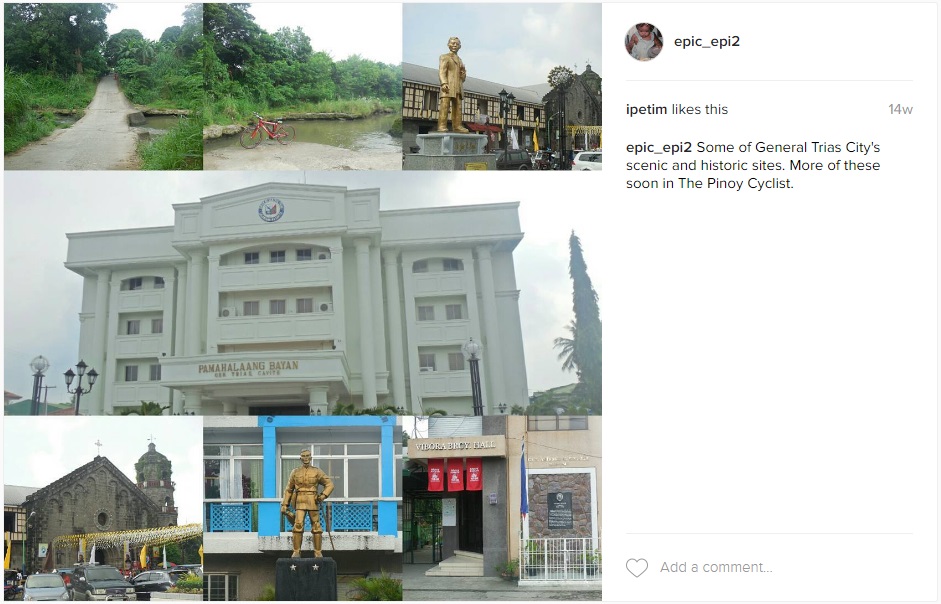
Through the wonders of Google Street View, I found a shortcut from my house to General Trias, Cavite’s newest city. In under two hours, I reached the historic city by passing through Patindig Araw in Imus City and Advincula Avenue in Lancaster New City. Among the places I visited were the St. Joseph the Worker Cathedral, the old Potente house where Andres Bonifacio once stayed, and the Vibora Cemetery where Artemio Ricarte, a general in the 1896 Philippine Revolution was buried. I also passed by the Alapan Flag Memorial in Imus City, where the Philippine flag was first waved in battle in 1898 a few months before it was officially unfurled during the Declaration of Philippine Independence in Kawit.

October: Uphill to Tagaytay
Aside from Kaybiang Tunnel in Ternate, the only other destination in Cavite that attracts many cycling enthusiasts is Tagaytay City. The challenging uphill terrain, combined with the city’s cool, mountain climate, makes it a magnet of cyclists.

Initially, I thought that biking to Tagaytay would be physically taxing for me given the terrain and distance. But since I was able to conquer Kaybiang Tunnel and the extraneous, mountain trail leading to it, I could make it to Tagaytay as well. My only other fear is biking along Aguinaldo Highway, which is most dangerous thoroughfare in the province. Again, through the wonders of Google Street View, I was able to map a route along the inner roads of Silang, Cavite to reach the city.

Amid a major downpour that stranded me in Silang for an hour and despite the difficult trail I took, I reached Tagaytay City chilly and wet in five hours. After several obligatory photos with the Taal Lake as my backdrop, I went to Olivarez Junction and placed Red on a bus back home. Not bad for a first-time bike ride to the country’s second summer capital.

November: A Bike Tour of Intramuros
Capping my year of biking adventure is my Intramuros bike tour in November. I’ve always wanted to do a bike tour of the Manila’s historic walled city and only UNESCO World Heritage Site and document certain sights in the district that only a bike can reach.

In under three hours, I was able to reach Intramuros via C5 Extension, Ninoy Aquino Avenue and Macapagal Boulevard. I visited Casa Real in Plaza San Luis, among the few museums in Manila I have yet to visit. I also passed by the Bambike Ecotours where I chatted with Bambike founder Bryan McClelland who showed me around his shop. Dropping by La Monja Loca, I thought I was going to see performance artist and tour guide Carlos Celdran, but he was on vacation. But I didn’t forget to buy his signature bowler hat from his “Damaso!” protest at the Manila Cathedral.

The rest of the tour took me to the ASEAN Garden in Puerta del Parian where there were busts of different ASEAN leaders. Red and I also biked through the pockmarked brick alleys above the walls and took photos of some of the lesser-known monuments in the former fortress city.

Postscript: In 2017, I hope you’ll continue to join me as I document my cycling experiences around the country, and hopefully, in some parts of the world! Let me raise a virtual glass and say, “Here’s to more memorable cycling experiences in the next 365 days!” Cheers!

Like The Pinoy Cyclist on Facebook:

Saturday, October 15, 2016

Cycling the Cavite-Manila route

There comes a time in every Pinoy cyclist’s life when you have to bike to the country’s capital city, Manila

This comes as a particularly tough challenge for me since I live in Cavite, and Manila is around 24 kilometers from our house. But this isn’t a challenge for the many construction workers that bike between Manila and Cavite to work on various infrastructure projects in the city. 

I’ve seen some of these folks during my daily commute to the capital. Most of them use mountain bikes given the bumpy conditions of roads leading to Manila, while a handful are in hybrids and road bicycles. It’s their daily ordeal the basically inspired me to purchase my bike, Red. Their bicycles cost around ₱2,000 to ₱4,000 but are very much dependable in different road conditions. 

From following them, I’ve learned that the usual route they take is through Las Piñas and Parañaque via Quirino Avenue. Of particular use to these cyclists is the Enrique Factor Road, a narrow passageway that passes under the Don Galo Bridge of the CAVITEX in Parañaque and connects Quirino Avenue to Diosdado Macapagal Boulevard. 

THROUGH LAS PIÑAS AND PARAÑAQUE
I took on the challenge of cycling the Manila-Cavite route one cloudy December day in 2014. Red was relatively new back then, having been purchased just a month before. I wanted to test if it was possible to bike going to my work in Manila and back. 

From Bacoor, I entered Las Piñas and Quirino Avenue via the Zapote Bridge. The Las Piñas section of this road has two lanes and is asphalted, but it gets even narrower because of the many vehicles parked on the side of the road. It passes through much of what was Las Piñas during the Spanish Era. Among the typical landmarks are the St. Joseph’s Church (home to the Las Piñas Bamboo Organ), the Plaza Real where the town hall used to be before it was transferred in Barangay Pamplona, and Plaza Quezon, the center of Christmas lantern-making in the city. 

The section of Quirino Avenue along Parañaque is no different from the Las Piñas section. The road is literally a headache in front of the Parañaque Public Market near St. Paul’s College and St. Andrew’s Church because of the heavy traffic in the area. After crossing La Huerta Bridge, take a left turn at the first corner, which is Balagtas Street. It leads to the Don Galo Barangay Hall and Plaza as well as the Chinese Temple. This where Enrique Factor Road starts and leads to Macapagal Boulevard. 

Given that two major churches (St. Joseph’s Church and St. Andrew’s Church) are found along Quirino Avenue, the road experiences heavy traffic buildup on Sundays. To avoid this, an alternative route is through the C5 Extension Road and the Ninoy Aquino Road. This route is wider as it passes through a four-lane, cemented road, but vehicles tend to be faster here so take extra caution. 

The C5 Extension Road starts in Pulang Lupa, Las Piñas where it connects with the CAVITEX through a newly opened exit. Among the familiar landmarks include the Villar Sipag Center, the St. Exequiel Moreno Church, and SM Sucat, where the road connects with Ninoy Aquino Road. 

Biking along C5 Extension is a breeze given that there aren’t a lot of establishments yet along it. But it’s quite the opposite when you reach Ninoy Aquino Road. With the many informal settlers living along it, the road is notorious for numerous parked cars and business establishments that occupy the road’s outer lane and sidewalk. Occasionally, you’ll find a few pieces of broken glass, perhaps leftover from the roadside drinking sprees common in these communities, so steer clear of it. You’ll get to pass by the famous Air Force One nightclub and the Dampa Seafood Restaurant. 

You can reach Don Galo from Ninoy Aquino Road by taking a left turn at J. P. Rizal Road just in front of Duty Free Mall. This connects Ninoy Aquino Road with Quirino Avenue. From here, bike a few meters southbound and turn right to Balagtas just before you reach La Huerta Bridge. 

Once at Enrique Factor Road, just follow the road as it passes under CAVITEX and connects with Diosdado Macapagal Boulevard. 

The Manila Baywalk, taken during my first Cavite-Manila 
bike ride in 2014.
MACAPAGAL BOULEVARD AND THE MOA LOOP
Now, Macapagal Boulevard opened in 2002 with a whopping price tag of more than P800 million and yet it is already in dismal condition. The asphalt has eroded leading to bumps and cracks, particularly in the section where the NAIA Expressway is being built up until you reach past City of Dreams. The constant exposure to the elements and the high volume of vehicles passing in the area are probably the causes. 

The road was equipped with street lights that were installed by PAGCOR, but some sections of the road are completely unlit at night, especially between ICON Hotel and the decrepit Uniwide Coastal Mall. So bring ample lighting and wear a reflective vest just in case you find yourself in that section at night. 

From Diosdado Macapagal Boulevard, I took a left turn to Coral Way and entered the SM Bay City where much of the SM Mall of Asia complex stands. On weekends, this road is filled with all sorts of cyclists — professional racers, mountain bikers or even cyclists who just want to stay fit. This road, all the way through Seaside Boulevard, J. W. Diokno Boulevard, the Cultural Center of the Philippines and the Manila Baywalk becomes their playground. 

During the summer, the area also known as the MOA Loop becomes a usual staging ground for various running and cycling events such as Alaska Cycle Philippines. The area is so popular among bikers that there’s even a Biker’s Café at the San Miguel by the Bay along Seaside Boulevard. 

MANILA VIA CCP AND BAYWALK
A few minutes from the MOA Loop is the Cultural Center of the Philippines, which is another bikers’ haven. The newly renovated sidewalks in the area are perfect of sidewalk biking. These sidewalks aren’t made of bricks; its intricate patterns were “stamped” on the concrete during construction, so the surface remains even and level. It’s easy going up and down these sidewalks courtesy of the PWD access ramps that connect each sidewalk section. 

Reaching Roxas Boulevard, I made it point to try the newly renovated Manila Baywalk. The renovation, which at that time was being done in preparation for Pope Francis’ visit to the Philippines, featured bike lanes, lush greenery and more than ample seating areas. 

Unfortunately, biking along the newly renovated Baywalk isn’t as convenient as the MOA Loop or the CCP. The bike lane has sections that aren’t paved, particularly in front of the Manila Yacht Club, so I had to stray away from the bike lane and into Roxas Boulevard. Some parts are also blocked by the huge banyan trees and concrete bases where the colorful lights of the Baywalk used to stand and has since been removed. Hence, if you’re biking in the area, do so in a manageable speed so that you can steer clear of any obstructions along the bike lane.
Taking the obligatory photo with my bike 
in front of the Rizal Monument.
I heaved a sigh of relief upon reaching Luneta Park. It took me three and a half hours to complete the entire ordeal. My daily commute is still faster at an hour and a half to two hours maximum. Nevertheless, I proved that I can indeed take my bike to work if perhaps I left home earlier. After a two-hour rest at our office, I took the same route going home and arrived around eight in the evening. 

In the end, it was a dusty, smoggy, grimey, butt-pinching ride between Cavite and Manila. I’d be happy to put my bike under a bus the next time I’d think of biking to the capital city again!

Like The Pinoy Cyclist on Facebook:

Popular posts