Showing posts with label cycling. Show all posts

Friday, April 10, 2020

This pandemic is proof that we should all learn how to bike

A resident of Wuhan, China uses a bicycle to travel around the city amid suspension of public transportation due
to a government-imposed lockdown to prevent the spread of the deadly Covid-19 virus. Photo by Wu Hong/EPA

Nurses and doctors waiting for hours on end for a ride to the hospital. Construction workers forced to walk from Metro Manila to their home provinces for several days. BPO workers having to live in their offices as they can't leave their jobs and go home. Breadwinners with no choice but to walk to the supermarket and pharmacy and back to their homes.

I haven't written anything on this blog for a long time (my last post was in 2017). I have not biked in a long time too as I've been busy with work commitments. But I came out of my long hiatus to tell you this:

If there is one thing that the ongoing Covid-19 pandemic has taught us about mobility, it's that we should all learn how to ride a bicycle.

When the Covid-19 outbreak was suddenly declared a public health emergency of international concern on January 30, countries around the world immediately began to suspend all forms of air and sea travel.

Eventually, when the Philippines began to impose an enhanced community quarantine (ECQ) throughout Luzon on March 16, public transportation was suspended in a bid to prevent the virus from further spreading and claiming more lives.

With city buses, rail systems, jeepneys, taxis, and even tricycles and pedicabs prohibited from operating, many Filipinos who still needed to work were forced to walk from their homes to their workplaces. These include frontliners like doctors and nurses who are fighting the spread of the disease in various hospitals throughout the country.

While the government eventually provided these frontliners with free shuttle services to transport them to and from hospitals and other essential facilities, those who cannot avail of these shuttle services relied on what is available and permitted at the time: bicycles.

Those who already own bicycles were quick to adopt to these two-wheeled metal horses. For those who do not have one, a community of cyclists decided to solicit cash donations or collect bicycles donated by kind cyclists to provide frontliners with bicycles to use in their commute.

As bicycles can only carry one person, they're the ideal mode of getting from point A to B while practicing physical distancing at the same time. A cyclist wearing the required personal protective equipment (PPE) like a face mask, goggles, gloves and face shield can travel to their destination and evade people who are potential carriers of the virus.

With only one member of the family allowed to go out of the house during community-imposed window hours, bicycles are the perfect vehicle to use in accomplishing errands such as buying medicine and groceries. You can even take it along with you while queuing outside a store and doesn't take up much space when it needs to be parked. If you're planning to buy groceries, it's easy to fit your bicycle with baskets in front and in the back.

The usefulness of bicycles also beats other forms of mobility. Those using motorcycles and cars are limited by the amount of fuel they can carry and the unforeseen vehicle break down. With many fueling stations and repair shops closed, it's not the best way to move around a locked down metropolis. The bicycle reigns supreme over motorized vehicles as it is human-powered and a knowledgeable, experienced cyclist can easily bring spare parts and conduct repairs on the side of the road.

And then, of course, there is the understated ecological impact of bicycles. As they produce zero emissions, they're highly recommended if you want to have a commute that takes care of the planet. As the enhanced community quarantine cleared our skies of air pollution from vehicles and factories, Filipino have found a greater sense of environmental responsibility. This renewed appreciation for cycling is an expression of that responsibility.


It's ironic that we've taken bicycles and cycling for granted before this pandemic started. Local governments have either not given bicycle infrastructure enough consideration or totally ignored the idea. Our car-centric society has placed a premium on four-wheeled vehicles instead of these handy two-wheeled metal horses. This pandemic has made us realize that bicycles and cycling are an essential mode of public transportation — one that can withstand various crises like pandemics, cataclysms and armed conflict.

When this all over, I sincerely hope that our nation's attitude toward bicycles and cycling changes. After this pandemic, the government should include cycling as a mandatory part of the Physical Education subject in elementary and high school curricula. May it also spur the government to invest in the promotion of cycling as a mode of transportation and in the construction of bicycle infrastructure like bicycle lanes and bicycle parking racks. May it also lead to greater enforcement of laws and enactment of more stringent policies designed to combat air pollution so that more Filipinos would be encouraged to take up cycling.

As in countries like Denmark, The Netherlands and Japan, may our new-found appreciation for biking bring about the rise of a biking culture that seamlessly integrates these two-wheeled metal horses into every aspect of community life.

Like The Pinoy Cyclist on Facebook:

Thursday, February 16, 2017

A cool cycling trip to Tagaytay


My bike, Red, with Taal Lake and Taal Volcano on the background.
By now, you’ve probably noticed already the sudden drop in temperatures these past weeks. Some parts of Benguet Province are a freezing -2° Celsius, while in Metro Manila, it’s been fluctuating between 21° and 24° Celsius. It’s winter in many parts of the northern hemisphere and cold winds coming from Siberia, China and Japan are being blown into the country. Waking up these days are defined by sweater weather and cold feet. Taking a bath necessitates having hot water mixed with the tap water in your pail.

This is also a great opportunity to bike, given that it’s not too hot in the day and the chilly amihan provides a lot of ventilation.

And one of the many destinations that bikers in the Philippines love to go to in this kind of weather is Tagaytay City in Cavite, the Second Summer Capital of the Philippines after Baguio City in Benguet.

Last October, I attempted my first-ever bike ride from Bacoor to Cavite’s City of Pines. It’s a 35-kilometer distance from my home through uphill roads and foggy terrain (depending on the weather). 
Normally, bikers take the usual route via the Aguinaldo Highway, the main artery that passes through Cavite from Bacoor to Tagaytay City. However, the highway also has a reputation for being accident prone for both bicycles and motorists. Being that my safety is of my foremost concern, I decided not to go up to Tagaytay through the highway.

Instead, I took the safer route via the country roads of Silang to reach the city. From Bacoor, it’s just a straight line to Governor’s Drive in Paliparan, Dasmariñas City, where the Molino-Paliparan Road connects to Paliparan-Road that would lead me to the backdoor of Silang town.

I realized I never really talked about biking along Molino-Paliparan Road. This 23-kilometer road runs from Talaba Junction in Bacoor and goes all the way south to Paliparan, Dasmariñas City. Among the major roads in Bacoor that connect through it are Aguinaldo Highway, Bacoor Boulevard and Daang Hari. It also intersects with Salitran Road and Governor’s Drive in Dasmariñas City. It is probably one of the oldest roads in Bacoor since it passes through some of the older barangays of Bacoor like Aniban, Ligas and San Nicolas. As such, throughout much of its stretch through these barangays, the road is a two-lane asphalt that widens once you reach the barangays of Molino. Bikers must share the road with motorists in this section so tread carefully.

From Molino I to Paliparan, it transforms into a four-lane cemented road because much of the road widening can only be done in the newer barangays of Bacoor and Dasmariñas City. However, because of the widening, motorists tend to hog even the outer lanes, especially at intersections along Bacoor Boulevard and Daang Hari where traffic is common. After passing SM City Molino, it’s generally smooth sailing until you reach Paliparan.

After a rest at a 7-11 along Governor’s Drive in Paliparan, I made my way to the Paliparan-Silang Road, which is just a few meters to the right. Your landmark would be the Paliparan Barangay Hall. Paliparan-Silang Road is a two-lane concrete road that runs through subdivisions and sugarcane plantations in Dasmariñas and Silang. You would know you’re already in Silang because you’ll pass by a marker with a large clay pot on top. The Silang section of the road begins to have an incline because of the increasing elevation. You’ll also notice that flower and pineapple plantations, as well as flower and plant gardens begin to line the side of the road.

Before noon, I reached Silang Proper. I didn’t pass through downtown Silang though and instead pedaled through the back streets of the town. I had lunch of rice and dinuguan in one of the carinderias along Sabutan-Iba Road. After that, I made my way to Ulat Road, which is an old, two-lane road that leads all the way up to the Santa Rosa-Tagaytay Road. The uphill terrain is more pronounced here than in the previous roads. There were sections that I had to literally get off the bike and push forward. To make things worse, it began to rain and despite wearing a raincoat, I was drenched in sweat and moisture underneath. I was forced to stop and take shelter at a store in Brgy. Balite.

Posing with my bike to beautiful backdrop of Taal Lake behind.
Finally, after about an hour, the rain stopped, and I proceeded despite being wet, shivering and pedaling uphill. At around 2:30 p.m., I reached Santa Rosa-Tagaytay Road just near Tagaytay Haven Hotel, but still a few kilometers from a decent view of Taal Lake.

After an hour’s rest at a sari-sari store near Tagaytay Haven Hotel, I continued my journey southwest along Santa Rosa-Tagaytay Road. There’s plenty of traffic once you’re near the Tagaytay City Public Market because of an ongoing road construction. Plus, it was a Sunday, so there’s a bigger volume of vehicles on the road. Do take care while biking along this road because there are plenty of trucks and buses that ply this two-lane asphalt road that has no provision for sidewalks. Use hand signals to indicate turns or stops.

Around 3:30 p.m., I finally reached the Tagaytay-Calamba Road in front of the Tagaytay Econo Hotel. From there, one can already get a spectacular view of Taal Lake and Taal Volcano. I was shivering in the 24° Celsius weather, but I still made a few obligatory shots to record my achievement.

Having made it to Tagaytay, the next predicament was going home. Since it was already past the middle of the afternoon, I figured I’m going to be on the road until nightfall. It’s going to be a scary, dangerous gamble if I pedaled the way I came or if I go back via Aguinaldo Highway with only a lamp as my light. I decided not to take the risk and headed to Tagaytay Rotunda where I took Red and myself aboard a Baclaran-bound bus and went down at Patindig Araw, Imus, where I pedaled the rest of the way going home.

My total bike distance and time via MapMyRide.
All in all, my bike ride from Bacoor to Tagaytay was 35.49 kilometers long, which I completed in just four hours and five minutes. Not bad for an inaugural bike ride to the country’s Second Summer Capital. But for all the toils and sweat I poured for this tour, it was one of the coolest bike rides I’ve ever been to. I’ll definitely go back to Tagaytay this year and see if I can bike to and from it.

Like The Pinoy Cyclist on Facebook:

Sunday, January 1, 2017

2016: A year of cycles and pedals


Another turn of the year has passed. This is usually the time to look back at some of the major events that happened in the past 365 days. Hence, the multitude of year-end TV specials that air around this time. Being a well-traveled person, my journeys have allowed me to experience cycling in some of the most beautiful places to bike in the country. Here are my top cycling experiences of 2016:

February: Biking in Legazpi
Recently, I’ve taken up the practice of traveling alone to some far-off destination in the country. This started in 2015 when I backpacked through Negros Island and Siquijor. Having saved enough money this year, I set my sights on visiting Legazpi City in Albay to see Mayon Volcano. And just like what I did in Siquijor, I also took the opportunity to experience biking in this new destination.

Luckily, Legazpi City has some of the best bike infrastructures I’ve seen in the country, with bike lanes along Legazpi Boulevard and other major streets. There is also a bike shop, Motoragon Bike Shop and Bike Tours, that offers affordable bike rentals. When I visited the shop, it so happened that my celebrity idol, Rovilson Fernandez, was also taking a bike tour with the shop owner for his Malaysian travel show. The shop let me borrow a folding bike, which I used to go around the city looking for fancy restaurants and cool sights and activities. It was exhilarating biking around the city at night. By 9 p.m., the streets were literally deserted with very few vehicles on the road. If only it didn’t rain that hard on my second day there, I would’ve enjoyed the experience even more.

May: Giro di Luca in Bohol
When I first heard from my company that they’re sending me to Bohol for the annual Giro di Luca cycling event, I thought I died and went to bike heaven. After all, it’s quite out of this world for your company to send you and your bike to one of the most beautiful places in the Philippines just to bike!

Giro di Luca is an annual cycling event in Bohol that’s been going on for the last four years. It was established by veteran cyclist Gianluca Guidicelli, father of Kapamilya star and Ford Forza Triathlon member Matteo Guidicelli. My company sent me and my bike to the event as part of Ford’s promotional activities. They wanted me to experience the race for myself and see how reliable Ford’s fleet of vehicles were during the race. The three-day event covers as total of 500 kilometers in distance, which the cyclists must complete in three legs: Panglao to Guindulman in Day 1, Panglao to Carmen in Day 2 and Panglao to Tubigon on Day 3.

To make the story short, Red, my humble, 4,000-worth bicycle, was able to ride an airplane (in an embarrassing wraparound of box cartons) and ride with some of the biggest names in cycling in the country and abroad (including SportsU anchor Dyan Castillejo and Australian cycling power couple Belinda and Justin Granger)! And while I didn’t finish the race because of the physical toll of the distance, I saw how idyllic and picturesque it is to go around Bohol in a bicycle. It was a whole new way of experiencing Bohol.

September: Pedaling to General Trias
I’ve always wanted to visit Cavite’s other towns and cities on a bike. In 2015, Red and I reached Cavite City, Noveleta, Kawit, Rosario, Tanza, Ternate, Maragondon, GMA, and Carmona, while I’ve always biked through the cities of Bacoor, Imus and Dasmariñas since I was in my teens. That leaves the other upland towns and cities of Cavite for me to visit.

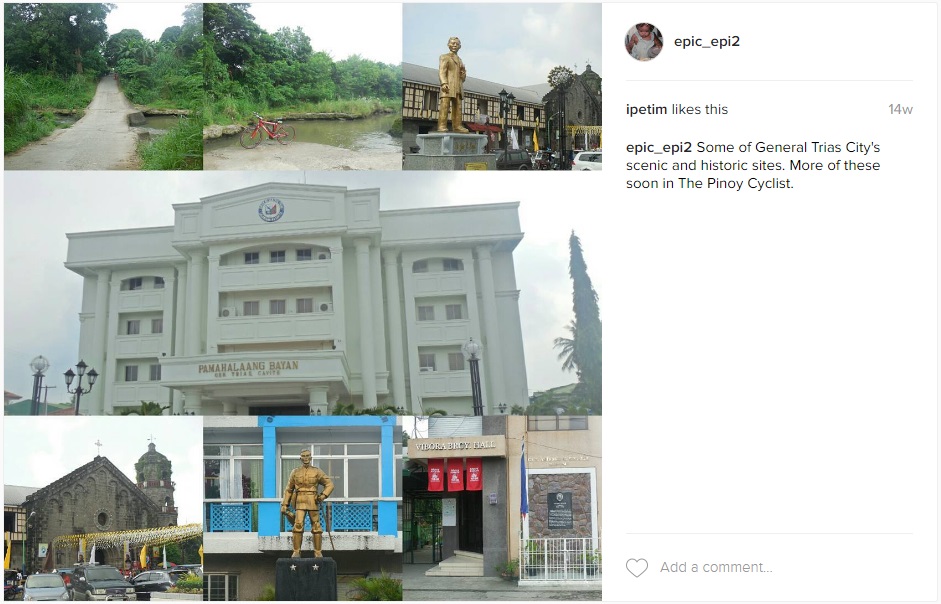
Through the wonders of Google Street View, I found a shortcut from my house to General Trias, Cavite’s newest city. In under two hours, I reached the historic city by passing through Patindig Araw in Imus City and Advincula Avenue in Lancaster New City. Among the places I visited were the St. Joseph the Worker Cathedral, the old Potente house where Andres Bonifacio once stayed, and the Vibora Cemetery where Artemio Ricarte, a general in the 1896 Philippine Revolution was buried. I also passed by the Alapan Flag Memorial in Imus City, where the Philippine flag was first waved in battle in 1898 a few months before it was officially unfurled during the Declaration of Philippine Independence in Kawit.

October: Uphill to Tagaytay
Aside from Kaybiang Tunnel in Ternate, the only other destination in Cavite that attracts many cycling enthusiasts is Tagaytay City. The challenging uphill terrain, combined with the city’s cool, mountain climate, makes it a magnet of cyclists.

Initially, I thought that biking to Tagaytay would be physically taxing for me given the terrain and distance. But since I was able to conquer Kaybiang Tunnel and the extraneous, mountain trail leading to it, I could make it to Tagaytay as well. My only other fear is biking along Aguinaldo Highway, which is most dangerous thoroughfare in the province. Again, through the wonders of Google Street View, I was able to map a route along the inner roads of Silang, Cavite to reach the city.

Amid a major downpour that stranded me in Silang for an hour and despite the difficult trail I took, I reached Tagaytay City chilly and wet in five hours. After several obligatory photos with the Taal Lake as my backdrop, I went to Olivarez Junction and placed Red on a bus back home. Not bad for a first-time bike ride to the country’s second summer capital.

November: A Bike Tour of Intramuros
Capping my year of biking adventure is my Intramuros bike tour in November. I’ve always wanted to do a bike tour of the Manila’s historic walled city and only UNESCO World Heritage Site and document certain sights in the district that only a bike can reach.

In under three hours, I was able to reach Intramuros via C5 Extension, Ninoy Aquino Avenue and Macapagal Boulevard. I visited Casa Real in Plaza San Luis, among the few museums in Manila I have yet to visit. I also passed by the Bambike Ecotours where I chatted with Bambike founder Bryan McClelland who showed me around his shop. Dropping by La Monja Loca, I thought I was going to see performance artist and tour guide Carlos Celdran, but he was on vacation. But I didn’t forget to buy his signature bowler hat from his “Damaso!” protest at the Manila Cathedral.

The rest of the tour took me to the ASEAN Garden in Puerta del Parian where there were busts of different ASEAN leaders. Red and I also biked through the pockmarked brick alleys above the walls and took photos of some of the lesser-known monuments in the former fortress city.

Postscript: In 2017, I hope you’ll continue to join me as I document my cycling experiences around the country, and hopefully, in some parts of the world! Let me raise a virtual glass and say, “Here’s to more memorable cycling experiences in the next 365 days!” Cheers!

Like The Pinoy Cyclist on Facebook:

Tuesday, December 13, 2016

Biking hits and misses


Filinvest City, Alabang, Muntinlupa City
I’m back!

After a month’s hiatus due to a very busy November, I’ve been on top of the pedal again on Saturday for bike ride. Too bad though, I missed all the happenings during a much-anticipated National Bike Month due to a hectic work schedule and sickness.

What did I miss? Well, I missed two succeeding bicycle expos on two consecutive weekends. First was the iCycle 2016: Ride Pilipinas at the World Trade Center in Pasay City, and second was the PhilBike Expo at the SMX Convention Center at the SM Mall of Asia. I had a terrible case of peptic acid disease for three weeks. I also missed National Bicycle Day on November 27 because I had to attend a godchild’s baptism.

But what did I do during those weeks I haven’t been behind Red’s handlebars?

A lot. Apparently, the Supreme Court had the guts to uphold the constitutionality of President Rodrigo Duterte’s order of burying former dictator Ferdinand Marcos at the Libingan ng mga Bayani. And within 10 days of that, the Marcos family surreptitiously buried their patriarch at the heroes’ cemetery.

To cut to the chase, aside from a constantly aching tummy and a frantic work itinerary, what kept me mostly busy on the weekends was attending to anti-Marcos rallies in Luneta and EDSA. I felt it’s my duty to join the rallies and voice out my disgust over the unjust Supreme Court ruling and hasty (if not clandestine) Marcos burial. There is a sense of purpose in being able to attend these protest actions and join forces with people who share the same ideals as me.

And in attending these rallies, I was able to come across a number of fellow cyclists who share the same political stance and standards as myself (see photo).


Fellow cyclist John Edrian Atendido,
with his folding bike at the #SiklabBayan
anti-Marcos protest in EDSA corner
White Plains last Nov. 30, 2016.
Anyway, December’s here and it seems that my work schedule has started to become less frenetic. Which is why on Saturday, I went back to my usual playground in Filinvest Alabang for a trail ride.

I made my way to the place via my usual shortcut at Pilar Village in Las Piñas City and tried some of the trails that I haven’t tried before when I got there. I also discovered that there was an event there last Sunday — the 2nd Philippine Bicycle Demo. 

The event is sort of a test drive festival just like the ones that Auto Focus has been conducting for three years now in the car industry. I brought together some of the best cycling brands in one venue: Specialized, BMC, Norco, Trek, Ibis, Colnago, Felt, Santa Cruz, Lynskey, Giant, Pinarello, Cervelo, Rocky Mountain, BH Bikes, Silverback, Brompton, KTIM, Bambike, Tern, among others.

All you need are two valid IDs, your own cycling gear (helmets, bike shoes, knee pads, pedals for certain bicycles) to be able to try out the bikes.

Unfortunately, I wasn’t able to come to this demo. I will explain in a while.

As I said earlier, I tried some the trials at Filinvest Bike Trail which I haven’t tried before, particularly the trails along Pacific Rim Extension near The Levels and CommerceCenter. There is one particular trail that goes up a steep hill where the Ayala Alabang water catchment is located. Up there is one of the best views of Filinvest City. I took a couple of pictures and time lapses before I biked downhill.

I made my way back to the Playground trail near The Palms and was thrilled by the number of mountain bikers that were on the same trail as me. I was also finally able to get the proper shifting combination for uphill sections of the trail which made pedaling easier.

I was so caught up in the thrill of the moment that I wasn’t thinking about safety anymore. As I was about to go down from the trail at Parkway Avenue, I preempted a left turn which I was supposed to make once I reached the sidewalk. I made the turn while still on the slope of the trail at a fast pace, causing me to fall and hit my knee on bare ground. I wasn’t wearing knee pads and so I instantly felt the stinging pain of hard ground grinding the skin off my knee.

It bled a lot, but I immediately poured water on it and tried to abate the bleeding by putting a clean towel on the wound. It was quite a big gash which stretched from the base of my left knee to the middle of left leg. I even tried trying the towel with a race tag from Giro de Luca 2016, which was the only long and adhesive material that I can get my hands on, and then made my way to nearby Festival Mall.

The towel and the race tag didn’t hold that quite long, and so I let the wound become exposed for a while as I made my way to Festival Mall. Once there, I quickly went inside an SM Savemore supermarket to buy first aid materials at Watsons to treat my wound. I cleaned it with Betadine solution and alcohol then dressed it with gauze.

My injured left leg, all cleaned and dress up.
I rested for a few minutes before deciding that I should go back home because of my condition. My plan was to take the bike on a bus going to Las Piñas City, but the bus driver won’t let me. So I had no choice but to bike all the way back to our house in Cavite on the same route I used earlier.

My first bike ride after a month’s hiatus ended with my first serious bike injury. I’m just glad that it was only a gash on the knee and not a blow to the head or back. Looks like I’m gonna have to wait for this leg to heal first before going back on top of the wheels.

Always remember folks, safety first when biking!

Like The Pinoy Cyclist on Facebook:

Monday, October 31, 2016

A perky cycling club for weekend warriors


For my last blog post this month, let me tell you something that happened more recently.

Last weekend, I was supposed to bike from Cavite to Manila in a planned tour of the city after more than a year (see previous blog entry).

On this particular route, I passed through Las Piñas City via Molino Dam, Zapote River Drive, Alabang-Zapote Road and Quirino Avenue. Just as I reached C-5 Extension Road in front of St. Ezekiel Moreno Church in Pulang Lupa, I chanced upon a jaw-dropping bicycle road race.

At first, it looked like professional road bikers in a major biking event that must have not known about. There were guards and marshals in motorcycles following and directing the peloton, so I was really convinced I ran through an major event without permission. But since no one tried to warn me and since cars and other passersby were still allowed to pass on the outer lane of the road, I kept pedaling. 

A few distances later, near the Petron station, were a group of bikers and viewers watching the race from the sidewalk. Behind them, a table with the race medals and prizes. A tarpaulin that clandestinely hung from the trees behind it said, "PERC: Philippine Executive Road Cycling Club." That's when I realized I chanced upon an official race of a well-known and established cycling club. I remembered having joined their Facebook group, but I didn't know they had a race that day or any races at all.

I stopped by the same curb and watched the race with childish enthusiasm. Took photos of the action each time the peloton passed in front of me. I also checked the medal table out. There were two categories: an Open category and a Managers, Big Boys and Women's category. Prizes were brand-new bike helmets, aside from the medals and trophies. I talked to one of the women near the medal table who told me that a certain Ernie was the brainchild of the event and that he was racing as well at that moment.

The weekly PERC tune-up race along C5 Extension Road
I waited until the race finished so I can interview the man himself and find out what this race is all about. As I waited, I also saw that many of the bikers were members of other cycling groups too like Franzia, Arctic PAGSS, Team Salic, among others.

After the race, everyone was in a jovial mood as they parked their bikes and caught up in each other's stories. One of the racers announced the race results, and each of the winners were called on the curb to receive their medals and prizes. It was then that I saw the man I was looking for: Ernesto Hortaleza, son of Hortaleza Salon, Beauty Products and Vaciador Cresencio Hortaleza.

According to Hortaleza, PERC is just a new bicycle club that's been in existence for around two months.

"We created this club for executives, managers, and employees who are looking for a weekend cycling experience to relieve their work stress. We organized these tune up races as a way to relieve that stress through competitiveness, sportsmanship and camaraderies," Hortaleza said.

He added that while the particular race was held in C5 Extension Road, there are plans to bring the race to other parts of the metro to reach more people.

PERC founder Ernie Hortaleza (first from right) with his wife and fellow cyclists
PERC is very open to blue and white collar professionals who want to join the club. You just have to present certain registration documents verifying your work details as well as pay a small membership fee. Their weekend tune up race also has a small registration fee of P100.

If you're a corporate executive or rank and file employee looking for a weekend race to vent out all your exhaustion, build your fitness and start an active lifestyle, PERC might be just the perky cycling club you're looking for.

Like The Pinoy Cyclist on Facebook:

Saturday, October 15, 2016

Cycling the Cavite-Manila route

There comes a time in every Pinoy cyclist’s life when you have to bike to the country’s capital city, Manila

This comes as a particularly tough challenge for me since I live in Cavite, and Manila is around 24 kilometers from our house. But this isn’t a challenge for the many construction workers that bike between Manila and Cavite to work on various infrastructure projects in the city. 

I’ve seen some of these folks during my daily commute to the capital. Most of them use mountain bikes given the bumpy conditions of roads leading to Manila, while a handful are in hybrids and road bicycles. It’s their daily ordeal the basically inspired me to purchase my bike, Red. Their bicycles cost around ₱2,000 to ₱4,000 but are very much dependable in different road conditions. 

From following them, I’ve learned that the usual route they take is through Las Piñas and Parañaque via Quirino Avenue. Of particular use to these cyclists is the Enrique Factor Road, a narrow passageway that passes under the Don Galo Bridge of the CAVITEX in Parañaque and connects Quirino Avenue to Diosdado Macapagal Boulevard. 

THROUGH LAS PIÑAS AND PARAÑAQUE
I took on the challenge of cycling the Manila-Cavite route one cloudy December day in 2014. Red was relatively new back then, having been purchased just a month before. I wanted to test if it was possible to bike going to my work in Manila and back. 

From Bacoor, I entered Las Piñas and Quirino Avenue via the Zapote Bridge. The Las Piñas section of this road has two lanes and is asphalted, but it gets even narrower because of the many vehicles parked on the side of the road. It passes through much of what was Las Piñas during the Spanish Era. Among the typical landmarks are the St. Joseph’s Church (home to the Las Piñas Bamboo Organ), the Plaza Real where the town hall used to be before it was transferred in Barangay Pamplona, and Plaza Quezon, the center of Christmas lantern-making in the city. 

The section of Quirino Avenue along Parañaque is no different from the Las Piñas section. The road is literally a headache in front of the Parañaque Public Market near St. Paul’s College and St. Andrew’s Church because of the heavy traffic in the area. After crossing La Huerta Bridge, take a left turn at the first corner, which is Balagtas Street. It leads to the Don Galo Barangay Hall and Plaza as well as the Chinese Temple. This where Enrique Factor Road starts and leads to Macapagal Boulevard. 

Given that two major churches (St. Joseph’s Church and St. Andrew’s Church) are found along Quirino Avenue, the road experiences heavy traffic buildup on Sundays. To avoid this, an alternative route is through the C5 Extension Road and the Ninoy Aquino Road. This route is wider as it passes through a four-lane, cemented road, but vehicles tend to be faster here so take extra caution. 

The C5 Extension Road starts in Pulang Lupa, Las Piñas where it connects with the CAVITEX through a newly opened exit. Among the familiar landmarks include the Villar Sipag Center, the St. Exequiel Moreno Church, and SM Sucat, where the road connects with Ninoy Aquino Road. 

Biking along C5 Extension is a breeze given that there aren’t a lot of establishments yet along it. But it’s quite the opposite when you reach Ninoy Aquino Road. With the many informal settlers living along it, the road is notorious for numerous parked cars and business establishments that occupy the road’s outer lane and sidewalk. Occasionally, you’ll find a few pieces of broken glass, perhaps leftover from the roadside drinking sprees common in these communities, so steer clear of it. You’ll get to pass by the famous Air Force One nightclub and the Dampa Seafood Restaurant. 

You can reach Don Galo from Ninoy Aquino Road by taking a left turn at J. P. Rizal Road just in front of Duty Free Mall. This connects Ninoy Aquino Road with Quirino Avenue. From here, bike a few meters southbound and turn right to Balagtas just before you reach La Huerta Bridge. 

Once at Enrique Factor Road, just follow the road as it passes under CAVITEX and connects with Diosdado Macapagal Boulevard. 

The Manila Baywalk, taken during my first Cavite-Manila 
bike ride in 2014.
MACAPAGAL BOULEVARD AND THE MOA LOOP
Now, Macapagal Boulevard opened in 2002 with a whopping price tag of more than P800 million and yet it is already in dismal condition. The asphalt has eroded leading to bumps and cracks, particularly in the section where the NAIA Expressway is being built up until you reach past City of Dreams. The constant exposure to the elements and the high volume of vehicles passing in the area are probably the causes. 

The road was equipped with street lights that were installed by PAGCOR, but some sections of the road are completely unlit at night, especially between ICON Hotel and the decrepit Uniwide Coastal Mall. So bring ample lighting and wear a reflective vest just in case you find yourself in that section at night. 

From Diosdado Macapagal Boulevard, I took a left turn to Coral Way and entered the SM Bay City where much of the SM Mall of Asia complex stands. On weekends, this road is filled with all sorts of cyclists — professional racers, mountain bikers or even cyclists who just want to stay fit. This road, all the way through Seaside Boulevard, J. W. Diokno Boulevard, the Cultural Center of the Philippines and the Manila Baywalk becomes their playground. 

During the summer, the area also known as the MOA Loop becomes a usual staging ground for various running and cycling events such as Alaska Cycle Philippines. The area is so popular among bikers that there’s even a Biker’s Café at the San Miguel by the Bay along Seaside Boulevard. 

MANILA VIA CCP AND BAYWALK
A few minutes from the MOA Loop is the Cultural Center of the Philippines, which is another bikers’ haven. The newly renovated sidewalks in the area are perfect of sidewalk biking. These sidewalks aren’t made of bricks; its intricate patterns were “stamped” on the concrete during construction, so the surface remains even and level. It’s easy going up and down these sidewalks courtesy of the PWD access ramps that connect each sidewalk section. 

Reaching Roxas Boulevard, I made it point to try the newly renovated Manila Baywalk. The renovation, which at that time was being done in preparation for Pope Francis’ visit to the Philippines, featured bike lanes, lush greenery and more than ample seating areas. 

Unfortunately, biking along the newly renovated Baywalk isn’t as convenient as the MOA Loop or the CCP. The bike lane has sections that aren’t paved, particularly in front of the Manila Yacht Club, so I had to stray away from the bike lane and into Roxas Boulevard. Some parts are also blocked by the huge banyan trees and concrete bases where the colorful lights of the Baywalk used to stand and has since been removed. Hence, if you’re biking in the area, do so in a manageable speed so that you can steer clear of any obstructions along the bike lane.
Taking the obligatory photo with my bike 
in front of the Rizal Monument.
I heaved a sigh of relief upon reaching Luneta Park. It took me three and a half hours to complete the entire ordeal. My daily commute is still faster at an hour and a half to two hours maximum. Nevertheless, I proved that I can indeed take my bike to work if perhaps I left home earlier. After a two-hour rest at our office, I took the same route going home and arrived around eight in the evening. 

In the end, it was a dusty, smoggy, grimey, butt-pinching ride between Cavite and Manila. I’d be happy to put my bike under a bus the next time I’d think of biking to the capital city again!

Like The Pinoy Cyclist on Facebook:

Friday, October 7, 2016

City Biking in Alabang


In my previous post, I discussed my cycling experience in Las Piñas City. With its exclusive subdivisions and relatively narrow roads, cycling in this part of the south still feels suburban despite being a city. In this next post, I'll talk about my cycling experience in a city that's truly urban — Muntinlupa — particularly its Alabang district.

* * *
For those who haven't been to Muntinlupa, it's Metro Manila's southernmost city, lying in the southeastern portion of the capital region. It has roughly 42 sq. kms. of land area and a population of a little over 500,000. You can reach the city via the South Luzon Expressway (SLEX) from both north or south of the capital. Another passageway to the city is through the Alabang-Zapote Road in Las Piñas City. If you're coming from Cavite, the city is connected to the province via Daang Hari Road and the Muntinlupa-Cavite Expressway (MCX).

CITY BIKING PLEASURE
I haven't biked the entirety of Muntinlupa City. My Muntinlupa biking route is concentrated in its Alabang district, which is located on the central part of the city. Alabang is basically the city's central business district because most of the city's financial, commercial, business and retail centers are found in it. Two business parks divide the district: the Ayala-owned Madrigal Business Park and the Gotianun-owned Filinvest City.

Several malls can be found in the district including Alabang Town Center, Molito, Starmall Alabang, Commerce Center and Festival Mall, which is the largest. Various hotels and office towers are also located in the district, the tallest of which is the Insular Life Center composed of twin towers rising 140 meters each. 

But compared to the central business districts of Makati, Taguig and Pasig, the Alabang district doesn't feel overcrowded yet because of the slow pace of development. For most companies in Metro Manila, Muntinlupa seems like a far away place to locate a business. Much of the development is concentrated in the Northgate Cyberzone sector of Filinvest City as well as the Madrigal Business Park.

I believe the slow growth of the Alabang district is what made it attractive for some people to locate their business, to live in, and of course, to bike around. It doesn't feel crowded unlike Makati or Ortigas where there seems to be very little space to move around and relax. Alabang's streets are wide and smooth. There aren't a lot of bumps or gravel on the road that could hurt biker's tires. There are plenty of trees and plants lining the side of the road, providing bikers some shade as they pedal along the district. 

There are traffic lights at almost every intersection managing the follow of vehicular and pedestrian traffic. Pedestrian crossing are well marked while sidewalks are spacious and free of obstacles. Along Alabang-Zapote Road, from Isuzu Alabang to Alabang Town Center, there's even a stretch of service road for bicycles to pass through to avoid vehicular traffic. Filinvest City has no service roads, but it has spacious sidewalks for bicycles to pass through. At night, the streets are well lighted. You're definitely going to love night biking in Alabang.

The Riverside and Playground trails at Filinvest Bike Trails
BIKE TRAIL FUN!
Alabang is a pleasure destination not just for road cyclists but also for mountain bikers because of the Filinvest Bike Trail, which is located on the left side of Filinvest Avenue if you're coming from Cavite or Las Piñas. This is probably the longest bike trail in the south (although the Heroes' Trail in Taguig might be longer. I haven't been there yet so I'm not sure).

The Filinvest Bike Trail has eight different sections of varying difficulty and purpose. Two of the sections are race tracks where mountain bike races are occasionally held. There is also a playground trail, a freeway trail beside the Filinvest Exit going to SLEX and a riverside trail on the banks of Alabang River. I've tried the trail twice and had much fun with the race tracks and the riverside trail despite being on a hybrid road bike. Much of the riverside trail is shaded by trees. There's even a part of the trail where a tree branch arches over the trail that you have to really bend down in order to avoid it. It was an exhilarating experience passing through that part! The Filinvest Bike Trails really makes for a cool, action-packed GoPro video that you can show off to your friends.
River Park at Festival Mall
Molito at Madrigal Business Park
Once you're famished after biking, there are plenty of dining places in Alabang. If you're into affordable, freshly cooked street food, there's plenty of that along Alabang-Zapote Road near Jollibee Alabang and South Station. There is also a food court inside Festival Mall that offers affordable food choices and the mall has ample bike parking (unlike Alabang Town Center or Molito). There are also plenty of convenience stores located at the Aurora Building in Madrigal Business Park, Molito, Alabang Town Center, Caltex Alabang, Civic Prime Building in front of Festival Mall and South Station.

From Bacoor, I bike to Alabang via Marcos Alvarez Road in Las Piñas City. To avoid the Alabang-Zapote Road, I take shortcuts inside Pilar Village and T.S. Cruz Subdivision in order to reach the Daang Hari terminus at Madrigal Business Park, which is around 10 kms. Another option I take is through Daang Hari if there aren't too many speeding vehicles.

If you want to really feel what city biking is like without feeling surrounded by urban jungle and still be one with nature, pedal your way to Alabang, Muntinlupa on a weekend!

Like The Pinoy Cyclist on Facebook:

Tuesday, October 4, 2016

Pedaling around Las Piñas


I appreciate your reading of my second post about my Kaybiang Tunnel adventure. It means a lot to me that you're following my blog despite its being new. For my third post, I am going to write something closer to home, which many Southern cyclists will relate to.

One of my usual bike routes is Las Piñas City, which is the city next to my hometown of Bacoor. Its also the city where I used to work at, as I did my internship at one of the city's public schools and, eventually, finding a teaching job at one of the private schools in the city. I also know the city quite well because my first girlfriend lived there. When I first bought Red in November 2014, his first break-in bike ride was through the city.

Las Piñas City is an ideal place for biking because of its subdivisions. Most of the private villages here are interconnected because of the Friendship Route that the local government devised, allowing both cars and bicycles passage to avoid heavy traffic at the main thoroughfares such as Alabang-Zapote Road, Marcos Alvarez Road and Quirino Avenue.

It's not that biking in these two main thoroughfares are bad. I like biking on these two reads on the weekends, especially on Sunday mornings. But on the weekdays and weekend afternoons, these roads experience some of the worst traffic jams in Metro Manila as suburban families and individuals spend most of their time congregating in the many shopping malls along Alabang-Zapote Road. You do not want to find yourself squeezing your bike between cars and trucks along these busy highways. In fact, I almost met an accident once in Barangay Almanza near the former Toyota showroom because a car had tried to cut through my space on the road.

Nevertheless, if you pick the right time of the day for biking through these thoroughfares, it's going to be smooth pedaling.

My Las Piñas bike ride is mostly centered on the southern portion of the city, inside BF Resort Village, Philam Village, Moonwalk Village, and Pilar Village. I've also biked in the northern part of the city to visit St. Joseph's Cathedral in Barangay Daniel Fajardo once.

To get to the city, I either bike through any of its four entry points: 

1) Through Zapote Bridge above the Zapote River, which marks the border between Bacoor and Las Piñas. This can be a stressing bike route given that it passes through Bacoor City Public Market. Vendors, parked vehicles and pedestrians literally block space for moving vehicles and cyclists. At the bridge itself, the road narrows into a two-way street instead of a four-lane road. 

2) Through Molino Dam. This is the exciting route because it allows cyclists to bike on top of a Spanish-era dam for just ₱2.00, which is the price of passage through the dam to enter BF Resort Village. On the rainy season, when the Zapote River overflows on the dam, a cart ferries passengers across the dam for another ₱2.00. You can hitch yourself and your bike a ride on the carts if you pay extra. But when the rains are too heavy, the dam can be closed until the water level becomes manageable for the cart to cross. This is the fastest route for me because I can get to Las Piñas from my house in just 15 minutes tops. Not only is it fast, you also get the scenic view.

Molino Dam at the Las Piñas-Bacoor border during the wet (left) and dry (right) seasons.
3) Through Marcos Alvarez Road. The road and the barangays along it are considered the back alley of Las Piñas, hence, the proliferation of industrial factories and slum areas along this road. The 4.76-kilometer road begins in Barangay Talon Quatro beside Lozada Public Market and ends in Barangay Molino II in Bacoor City. The road starts as a two-lane asphalt road that could get pockmarked and bumpy. It's probably why they called one of the villages along it as Moonwalk Village because of the road's condition. Kidding aside, the road has an uphill section along Barangay Talon Singko in front of the Golden Acres National School. By the time you reach the Bacoor portion of the road, it shifts to four lanes, although much of the outer lane are occupied by parked vehicles. Plenty of gravel along this part that could puncture your tires and do watch out for the southbound portion of Santo Niño Bridge just past the SeaOil gas station because it has no concrete railings.

4) Through Daang Hari Road. This is the longest route going to the city from Bacoor. Being a four-lane boulevard and the terminus of the Muntinlupa-Cavite Expressway, vehicles here are naturally fast so take extra caution especially at night. Not a lot of establishments yet along this road, mostly exclusive subdivisions as well as two Vista malls (the Evia and Starmall Molino) There have been incidences of bicycle theft in the area, with cyclists being held at gunpoint by thieves. The terrain is uphill but smooth. Plenty of gravel though on the side, just as any other road in the Philippines.

Despite the urbanity that now prevails in Las Piñas, it is a city rich in history. The northern side of the city along the Manila Bay coast used to be the center of the salt-making industry in the south of the capital. Remnants of the Irasan Center in Pulang Lupa can still be seen be no salt can be raked from the salt flats that once dotted the city's coast.

The Bamboo Organ at St. Joseph's Cathedral
One historic landmark still standing though is the Las Piñas Bamboo Organ inside St. Joseph's Cathedral. Built in 1824 by former Spanish curate Fr. Diego Cera, the Bamboo Organ still used today and is a recognized National Cultural Treasure. The area around St. Joseph's Church is also known for lantern making. As the Christmas holiday nears, the area along Diego Cera Avenue are filled with makeshift stalls selling lanterns of various designs and makes.

Of course, I already mentioned the Molino Dam, which was constructed in 1885 to water the vast friar estates of Hacienda de San Nicolas. It was built under the initiative of Spanish priest and now Saint Exequiel Moreno.

Apart from pedaling along memory lane, there are plenty of food stops in this side of the metro, especially along BF Resort Drive and Alabang-Zapote Road.

Zapote River Drive a few months after it opened.
Recently, a new road was also built along the Las Piñas banks of the Zapote River behind BF Resort Village. The Zapote River Drive stretches from Barangay Pamplona Uno near Christ the King Church where it connects to Alabang-Zapote Road, and ends at Florlina dela Cruz Street in BF Resort near Molino Dam. From here, you can reach Marcos Alvarez Road via Carnival Park Street, Abel Nosce Street and the Apollo Streets of Moonwalk Village. The road has some narrow points that allow only one vehicle at a time to pass because of right of way issues. But with very few vehicles passing this route at a time, its a fast shortcut going across the city.

I pedal around Las Piñas when I have no long-distance biking plans in particular during weekends. Its also good exercise given the shifting terrain the city has. Sometimes, I also bike through the city at night when I want to exercise on weekdays after coming home from work. The parks inside BF Resort and Philam Village are also a cool and shady spot to rest after a round of pedaling. Las Piñas City is definitely an ideal cycling roundabout.

Like The Pinoy Cyclist on Facebook:

Popular posts